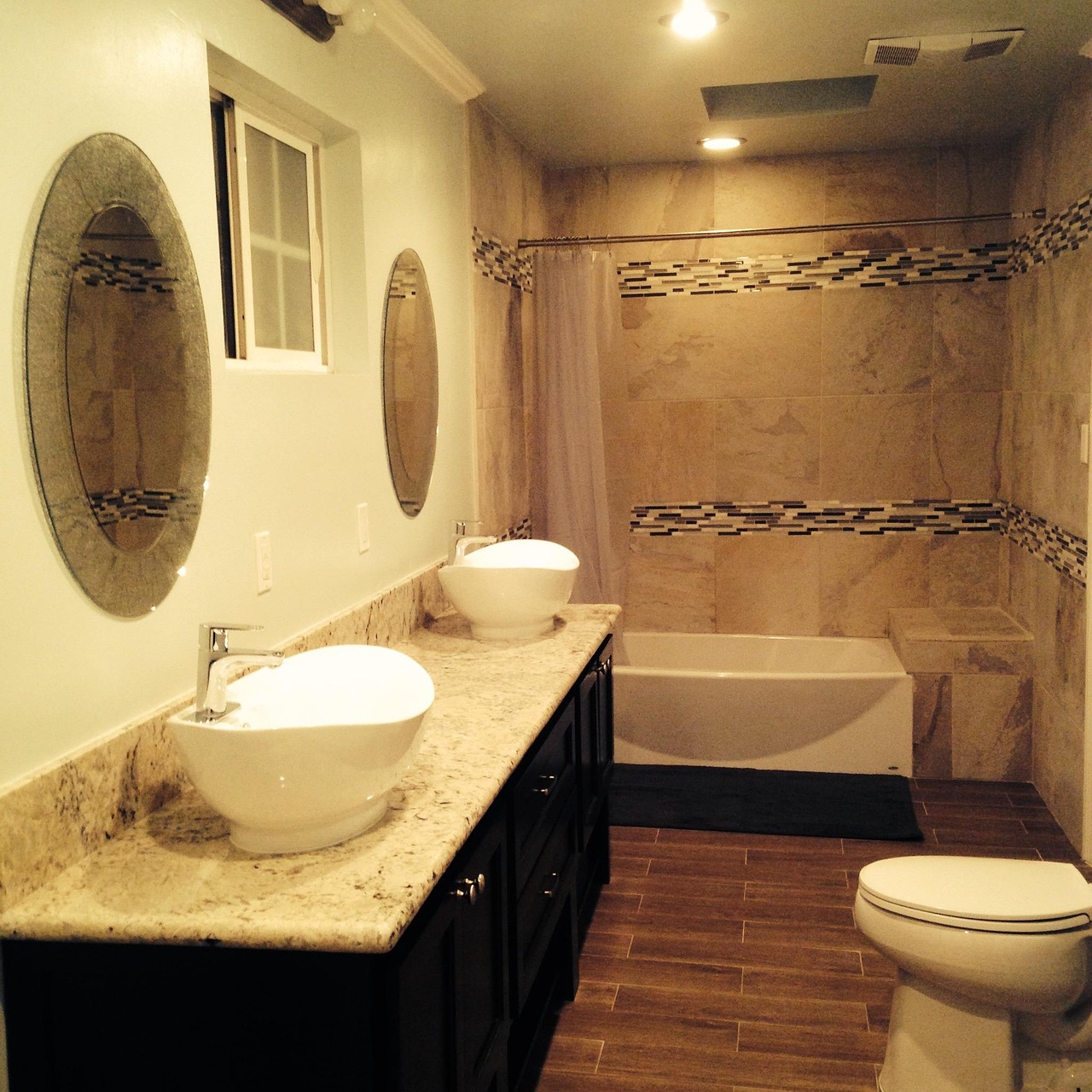
Bathroom remodeling in Ontario, CA covers the updates that make a bathroom easier to use, easier to clean and better suited to your household, from a new vanity and fixtures to a full renovation with a walk-in shower and new tile. It’s for Ontario homeowners with dated or worn bathrooms in older homes near downtown, postwar houses across the city, or newer homes in Ontario Ranch whose builder-grade baths no longer fit the way they live. We plan each project around the home’s construction, hard water, your family’s needs and your budget. The result is a bathroom that looks current and holds up to everyday use.
The Bathroom Work We Handle
Ontario remodels usually involve one or more of these core services, each explained in more depth:
- Shower remodeling: replacing fiberglass inserts and worn tile with larger tiled showers, walk-in designs and frameless glass.
- Bathtub installation: new soaking, alcove or walk-in tubs with updated surrounds and fixtures.
- Vanity installation: cabinets with better storage, quartz or stone counters, new sinks and faucets, including double vanities.
To finish the room we also install tile and flooring, new toilets, lighting and exhaust fans, and add safety features such as grab-bar blocking and low-threshold entries. Most whole-room remodels draw on all of these.
Ontario’s Homes and Their Bathrooms
Ontario’s housing covers more than a century, and the age of a home shapes what a bathroom remodel involves.
Older homes near downtown and Euclid Avenue
The neighborhoods around Euclid Avenue and north of downtown include homes from the early and mid-1900s, some within the Euclid Avenue Historic District. Bathrooms in these homes are often small and may come with:
- Original or decades-old plumbing that needs replacing during the remodel.
- Floors that have settled and need leveling before tile.
- Character details such as period tile that some owners want to echo.
- Limited electrical, with few outlets and no exhaust fan.
Postwar and late 20th-century neighborhoods
Large parts of central and southern Ontario filled in with single-story houses during the 1950s through the 1980s, and those homes tend to have one or two modest bathrooms. Typical upgrades include replacing tub-showers, adding storage and swapping out old vanities and toilets.
Ontario Ranch and other newer homes
In Ontario Ranch and other recent developments, homes are newer, but bathrooms were often finished with builder-grade fiberglass inserts, basic vanities and standard fixtures. The structure behind the walls is usually sound, which lets a remodel focus on finishes and layout: a bigger tiled shower, glass, a better vanity and improved lighting.
Hard Water and What It Means for Your Bathroom
Hard water is common across much of the Inland Empire, and it shows up in bathrooms first. Minerals leave white spots on glass, crusty buildup on shower heads and dull finishes on faucets, and they can shorten the life of valves and toilet parts. A remodel is a good time to plan around it:
- Choose finishes like brushed nickel or matte black that hide water spots better than polished chrome.
- Order shower glass with a protective coating to make cleaning easier.
- Pick large-format tile with fewer grout lines to scrub.
- Consider a water softener or shower filter if buildup is a constant problem.
- Use quality valves and cartridges that hold up longer and are easy to service.
Bathrooms for Busy and Multigenerational Households
Many Ontario homes are shared by large or multigenerational families, and a single bathroom may serve young kids, working adults and grandparents. Good planning makes that work:
- Two sinks or a long counter to ease the morning rush.
- A walk-in shower with a bench and handheld head that suits every age.
- Durable, easy-clean surfaces that stand up to heavy use.
- Plenty of closed storage so counters stay clear.
- Bright, even lighting at the mirror and in the shower.
Ventilation, Moisture and Long-Lasting Bathrooms
A bathroom that never fully dries is a bathroom that wears out early. Many older Ontario homes have no exhaust fan at all, and the fans in newer homes are often small, loud and vented into the attic instead of outside. Moisture that lingers soaks into grout, swells cabinet bases and peels paint around the ceiling. During a remodel we look at:
- Fan size matched to the room so steam clears in a few minutes.
- Ducting that runs to the exterior rather than ending in the attic.
- Quiet operation, since people actually run a fan they can’t hear.
- Humidity or timer switches that keep the fan running after a shower.
- Paint and trim rated for bathrooms.
Choosing Materials That Suit Ontario Homes
The best materials for a given bathroom depend on who uses it and how much care you want to give it. Porcelain tile is dense and resists stains, which makes it a dependable choice for floors and shower walls. Solid-surface or composite shower panels cut down on grout and suit owners who want quick cleaning. Quartz counters shrug off cosmetics and don’t need sealing. Luxury vinyl flooring is warm, quiet and water-resistant, a practical pick for kids’ bathrooms. We’ll lay out samples during planning so you can compare color and texture in your own lighting, which often looks different from a showroom.
How a Remodel Moves From Idea to Finished Room
- First conversation about the bathroom, the problems and what you’d like.
- Free in-home visit to measure and check plumbing, flooring and ventilation.
- Material and fixture selection, followed by a written proposal for the work.
- Permits pulled when the scope requires them.
- Tear-out and rough-in, with plumbing and electrical work as needed.
- New surfaces and fixtures: waterproofing, tile, shower or tub, vanity and toilet.
- Final touches, cleaning and a walkthrough of the completed bathroom.
What to Look for When Hiring a Bathroom Remodeler
- Clarity on the scope, including demolition, disposal, fixtures and patching.
- A named waterproofing method for any tiled shower.
- Realistic allowances if tile or fixtures haven’t been chosen yet.
- A plan for ventilation, since a new exhaust fan protects the investment.
- License and insurance you can verify; the Contractors State License Board website lets you check any California contractor’s license status.
Our Service Area
We serve Ontario, including the Euclid Avenue area, the neighborhoods around downtown and Ontario Ranch, along with Upland, Rancho Cucamonga, Chino, Montclair, Fontana and Eastvale. Call to check whether your neighborhood is in our area.